
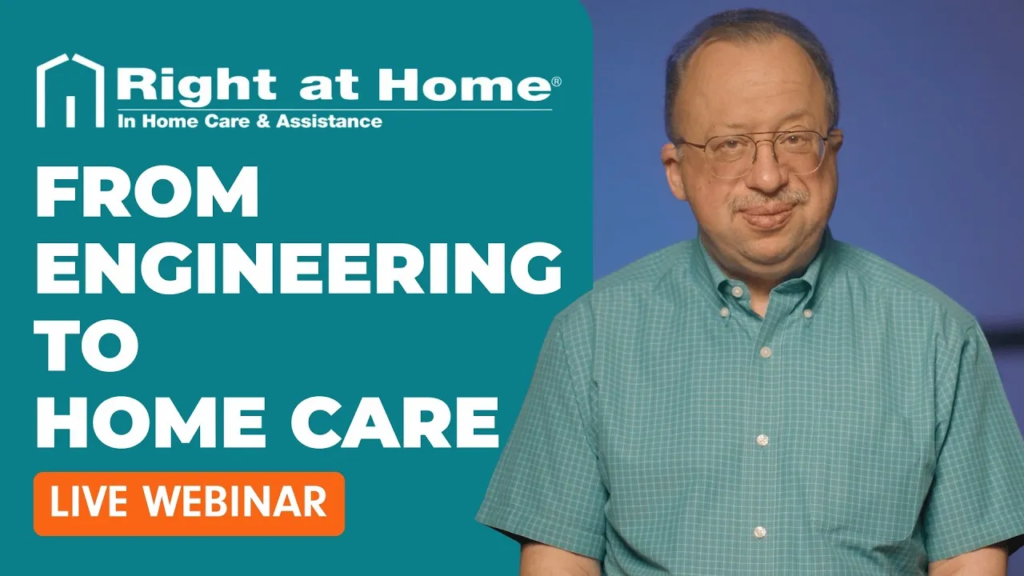
After years as a successful telecom engineer, Vladimir Zarkhin reached a point where corporate success no longer felt fulfilling. Searching for a business that combined purpose with entrepreneurship, he found that opportunity in the in-home senior care industry with Right at Home, a decision that has shaped more than two decades of his career.
“It was a combination of two things: something meaningful and mission-driven, and something entrepreneurial with a solid business opportunity,” Zarkhin said. “That’s how I came across home care as an industry. To me, that was the perfect combination of both worlds. It was a great business opportunity, but it was also a great mission.”
Zarkhin, owner of Right at Home of Boston Metro West, began exploring franchise opportunities in the early 2000s while looking for a new professional path. Over the past 20 years, he has built a successful business serving families across the Boston Metro West area while watching the senior care industry mature and expand.
What once required a great deal of explanation for referral partners and the public is now widely recognized as an essential service for aging populations. Even with that growth, Zarkhin said the purpose behind the work continues to drive him.
“It’s the way I live. It’s not just the office where I work or the services that are part of the job. It’s part of my life. I honestly cannot imagine it any other way,” he said.
Zarkhin joined 1851 Franchise Publisher Nick Powills on a recent episode of the “Meet the Franchisee” podcast to discuss his path into franchising, how the senior care industry has evolved over the past two decades and the mission-driven work that continues to motivate him today. A transcript of the interview has been provided below. It has been edited for brevity, clarity and style.
Nick Powills: How did you accidentally fall into franchising? What’s your franchise backstory?
Vladimir Zarkhin: I have to start from the fact that I worked in high tech. I was a member and manager in one of the groups. Unfortunately, we were placed on a special assignment where we had to maintain a certain product for the entire year. I was part of that group, and I had a lot of time on my hands. That’s when I decided I would probably be done with the corporate world.
Once I decided that, I didn’t send a single resume. The next question for me was, OK, what’s next? That’s when I started my soul searching and thinking about what would be the right fit for me.
When I looked back, it was a combination of two things: something meaningful and mission-driven, and something entrepreneurial with a solid business opportunity. That’s how I came across home care as an industry. To me, that was the perfect combination of both worlds. It was a great business opportunity, but it was also a great mission.
Once I settled on the industry, the next question was, OK, now that I know where I’m going to be, with whom am I going to partner? I literally called all the franchise systems that existed back in 2002. When I met Allen Hager and his team, the question was solved. The answer was clear. I said, yes, of course, it’s going to be Right at Home. Allen wasn’t just a great manager. He was a visionary, and his team was just as great as he was. That’s what settled it for me. That’s my story in short.
Powills: I love it. So a few comments. One, you were at the forefront of this industry. You were an early adopter. In a million years, would you have guessed that it would become what it is today? Did you predict that this was the direction it was going?
Zarkhin: No. First of all, I couldn’t predict that I would still be here in this business 23 years later. I had never worked anywhere that long before, so that was a huge surprise for me. But of course I couldn’t predict it. Things changed dramatically over the years. Back then, the main issue for me was education.
When I went to potential referral sources, the first question was, “What are you doing exactly? Private duty?” That was a stumbling block because they didn’t understand what the private duty industry was or how different it was. Now, fast-forward. I don’t have to explain it anymore. Everybody understands the industry, at least in the professional field.
Powills: It’s fascinating. I’ve been in franchising for 20 years, and I look at it through a traditional marketing and PR lens. When I first started working in senior care, if we called a member of the media and tried to explain the advantage of this business, they would ask, “What is this?”
The default assumption was that when you age, you go to a nursing home. That’s what we grew up with. Nobody thought this transformation would happen.
What’s also interesting is that 20 years later, the demand is still greater than the supply, which is crazy. Everyone understands the value of this now, especially for navigating the final stages of life. When you started, there wasn’t much competition. Now there’s a lot of competition, but it doesn’t matter as much because the demand is still so high.
Zarkhin: Yes. And probably my competition helps me as well because they educate people about the industry and what the industry does. I say thank you to my great competitors, because not all competitors are great. But those who are great, I respect them. I have some very good competitors, and we work together in many ways.
Powills: That’s another interesting thing about this space. A caregiver might work for multiple companies that appear to be competitors, but the mission is very similar across the board. It’s a category where competitors want to work together and support each other so the expectations for care stay high.
Zarkhin: That is correct. Those who don’t understand that usually don’t last very long. If you want to stay in this field for a long time, you need the mentality of working together and cooperating with competitors. Frankly, you also need to do a great job. If you’re here just for money, nothing is going to happen.
Powills: You said you didn’t expect to be in this industry this long. Do you ever step back and reflect on that accomplishment, or are you always focused on the next day?
Zarkhin: I do reflect, but I don’t think of myself as someone who accomplished something extraordinary over these 23 years. For me, it’s just my style of living. It’s the way I live. It’s not just the office where I work or the services that are part of the job. It’s part of my life. I honestly cannot imagine it any other way.
Sometimes I think about the fact that I just turned 60 and that I’m supposed to be thinking about retirement. But I don’t, because I don’t want to retire.
Powills: I love that statement. I’ve been thinking about that idea a lot. People talk about retirement because they don’t like the job they do. But when a job becomes a mission or a purpose, it becomes life. What you’re saying is that this isn’t just a job or a career. It’s life. That’s why retirement doesn’t matter.
Zarkhin: I have to say, Nick, I wasn’t angry with corporate America. I respect people who work there and are successful. These are personal decisions. What’s right for me may not be right for someone else. It’s very personal.
Powills: Where do you think the magic of your run comes from? Is it the people you work with or the customers?
Zarkhin: It’s the people. Around Right at Home and throughout this journey, I have met great people. If I have any accomplishment, it’s being able to meet and work with these people. I say that sincerely. That’s what makes my life great.
Powills: That’s life. People, connection and kindness.
Zarkhin: Yes, and sometimes frustration too. Sometimes people irritate you or make you angry. But even then, you appreciate being around people because it adds to your experiences and makes life interesting.
Powills: Many franchise owners in this space have a deeply personal connection to caregiving. How do you become comfortable working in a business that often serves people in the final stages of life?
Zarkhin: That’s a good question. I’m not sure what comfortable even means. Yes, we see people who are dying and in the last stages of their lives, but we focus on bringing dignity and respect to those moments. Because of that focus, the question of comfort doesn’t really arise.
We’re serving them. That’s what matters.
Powills: You mentioned dignity. The way we look at dignity in senior care has changed a lot over the years. Is that something you feel proud to have helped advance?
Zarkhin: Yes, dignity is the key word. We all have a one-way street in life.
Recently, one of our hospice clients was nearing the end of life. Our new chief operating officer, who is a nurse, stayed with the caregivers for the last two days of the client’s life. She sat with the person and sang with them.
When I heard that story, I said, “That’s the way I want to leave this world.” What makes me proud is that I surround myself with people like that.
Powills: That’s powerful. We celebrate birth so much, but we rarely celebrate dignity at the end of life in the same way. Yet those moments can also be joyful.
Zarkhin: Yes. That’s the experience I would want in my final moments.
Powills: When you first looked for a business with purpose, this is exactly what you meant.
Zarkhin: Exactly. Of course, we don’t think about purpose every day. We live normal business lives, solving problems and dealing with responsibilities. But it’s important to have that mission in front of us. Without it, nothing happens.
Powills: Looking back, do you wish you had started earlier?
Zarkhin: No. I don’t look back that way. I have no regrets. Everything in my previous life prepared me for where I am now. I’ve had many careers, and as you know, I’m an immigrant from another country. All of those experiences prepared me for this. And I’m sure this experience is preparing me for something else in the future.
Watch the full interview above or on YouTube.
If you’re interested in taking the next step in making a difference in your community as a Right at Home franchisee, visit https://rightathomefranchise.com/.